


We built it because families needed more support. Now a charity in Scotland has recognised the same problem.
Sometimes a conversation makes you realise that an idea which started from something deeply personal is part of something much bigger.
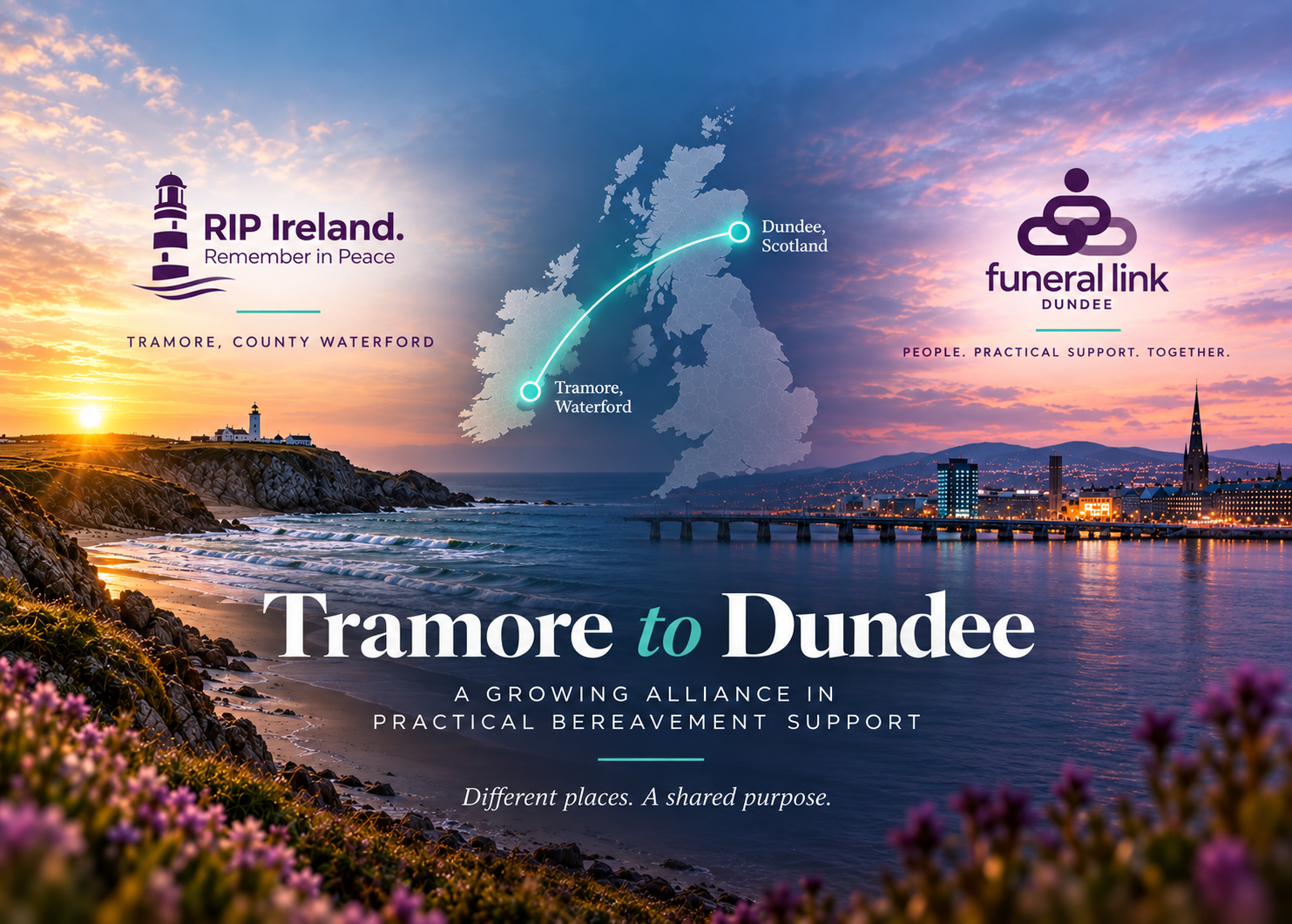
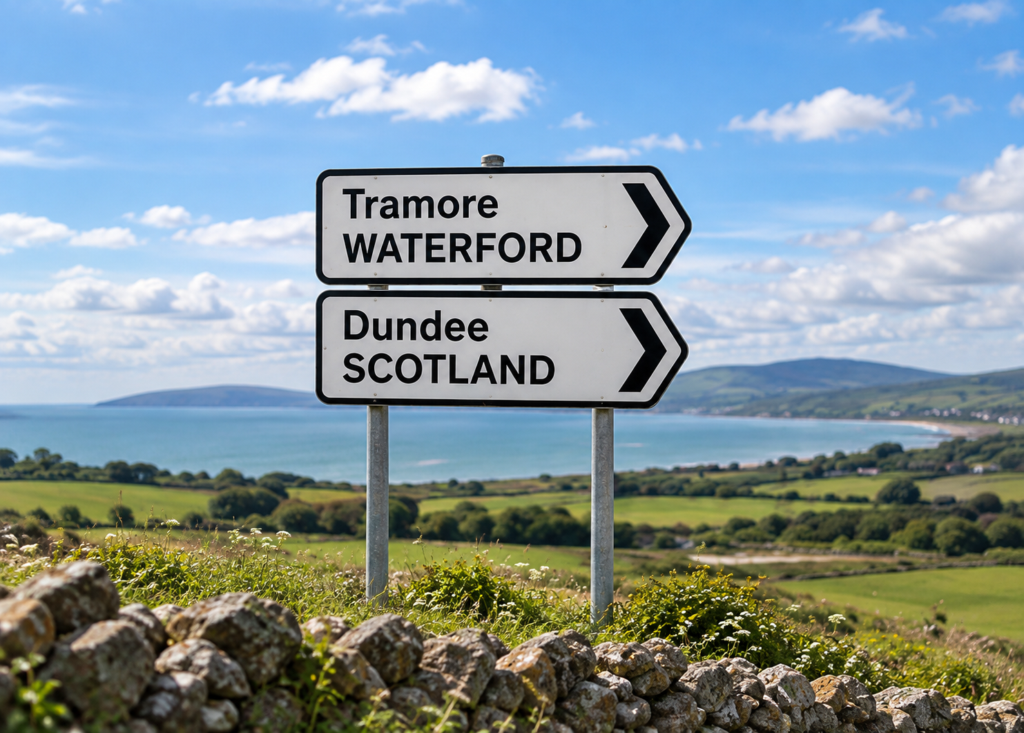
That happened recently when we began talking with Funeral Link in Dundee, Scotland.
Funeral Link is a charity doing extraordinary work with families who are trying to arrange funerals while facing financial pressure, uncertainty and grief.
They offer independent, one-to-one support, help people understand funeral costs and available benefits, assist with applications for financial support and connect families with other services when they need them.
Their purpose is very simple.
To reduce funeral poverty and help people arrange a dignified funeral without being pushed into harmful debt.
Before I say anything about RIP Ireland, I want to acknowledge that work.
To everyone at Funeral Link: thank you.
Thank you for the conversations.
Thank you for sharing what you are seeing on the ground in Scotland.
And most importantly, thank you for believing that what a very small team is building here in Ireland might have something meaningful to contribute.
We are at the beginning of forming an alliance.
But the values already feel remarkably familiar.
Dignity. Transparency. Practical support. Community.
And the belief that when somebody dies, the people left behind should not have to figure everything out alone.
My reason for starting RIP Ireland was my mother
Long before there was a website, a Memorial Wall or a company called RIP Ireland, there was a conversation between me and Erich Falconer.
My mother was ill.
At the time, I genuinely thought I might soon be arranging her funeral.
And I realised I had absolutely no idea what that would cost.
So I rang Erich.
I asked him a simple question.
“How much does a funeral cost?”
His answer stopped me.
Depending on the funeral, I could be looking at somewhere between €5,000 and €10,000.
I remember thinking about my own circumstances at that moment.
Could I find that money immediately?
The answer was uncomfortable.
It would have been difficult.
Then I thought about my mother.
She wasn’t someone who, in my view, would necessarily fall neatly into the category of receiving state assistance.
But she hadn’t put thousands of euro aside for her funeral either.
And suddenly I understood something I had never really thought about before.
There is an enormous group of people sitting in the middle.
They work.
They pay tax.
They raise families.
They have mortgages.
They might drive a decent car.
From the outside, everything may appear completely fine.
But that tells us absolutely nothing about whether they have €5,000, €7,000 or €10,000 sitting in a bank account when somebody dies.
Grief doesn’t means-test you before it arrives.
The people in the middle are too easily forgotten
That conversation became one of the foundations of RIP Ireland.
There are state supports for people who qualify.
In Scotland, Funeral Support Payment is targeted at people receiving certain qualifying benefits and contributes towards burial, cremation, transport and other funeral costs. It does not necessarily cover the whole funeral.
Ireland has its own mechanisms, including Additional Needs Payments in cases where somebody cannot meet essential expenses from their weekly income.
But between those systems and families with significant savings sits a huge number of ordinary working people.
The squeezed middle of bereavement.
Too well off on paper to look vulnerable.
Not wealthy enough to comfortably absorb an unexpected funeral.
These are some of the people we built RIP Ireland for.
And through our conversations with Funeral Link, we have realised that this isn’t an Irish problem.
It is a Scottish problem too.
It is probably a problem far beyond either country.
But RIP Ireland also came from my own experience of loss
There is another reason this matters so deeply to me.
I know what loss feels like.
I know the strange silence that follows it.
I know that period when everybody is around you and then, gradually, life resumes for everyone else.
People go back to work.
Messages slow down.
The house gets quieter.
And the person grieving can still be standing in exactly the same place emotionally.
We live in what should be the most connected generation in human history.
We can communicate with almost anyone on earth instantly.
Yet sometimes I think we have never been more disconnected.
We have hundreds of contacts.
Thousands of social-media connections.
WhatsApp groups.
Followers.
Likes.
But when somebody really needs us, we often still don’t know what to do.
So we say:
“If there’s anything I can do, let me know.”
We mean it.
But the person who is grieving is often the last person capable of organising everybody else’s kindness.
I started wondering whether we could change that.
Somewhere along the way, I went looking for purpose myself
After my divorce, I went to India.
I needed to get away.
To reset.
To understand myself again.
And, if I’m truthful, to work out what I wanted the rest of my life to mean.
There wasn’t one dramatic moment where everything suddenly made sense.
But one idea stayed with me.
One of the most powerful ways to heal yourself is to help somebody else.
When I came back, I began looking differently at what I wanted to build.
The more time I spent with Erich, the more I understood the funeral profession.
And the more I understood it, the more obvious the opportunity became.
Families needed more support.
Communities wanted to help.
Funeral directors were often carrying the financial pressure in between.
There had to be a better way of connecting all three.
So Erich and I put our own money behind it
RIP Ireland didn’t arrive through a giant funding round.
There wasn’t a multinational company behind us.
There wasn’t an enormous development department.
There were two people who believed the idea mattered enough to keep going.
Between us, Erich and I have now invested approximately €100,000 of our own personal savings into developing RIP Ireland.
That is a huge amount of money to us.
And it wasn’t invested because we thought Ireland needed another death-notice website.
It was invested because we believe the system surrounding bereavement can be better.
For families.
For communities.
And for funeral directors.
Every feature we build ultimately has to answer that test.
Does this make life a little easier for somebody after a death?
If it doesn’t, it shouldn’t be there.
Funeral directors are part of this story too
Something else became obvious as we learned more about the profession.
Funeral homes are compassionate businesses.
But they are still businesses.
They have employees.
Premises.
Vehicles.
Insurance.
Coffins.
Third-party costs.
Crematorium fees.
Suppliers.
And wages.
Like virtually every small business, cash flow matters.
Except funeral directors face a challenge most businesses don’t.
Their customer may be sitting opposite them on one of the worst days of their life.
Imagine having to ask somebody grieving the death of their mother:
“When will you be able to pay the balance?”
Nobody wants that conversation.
Not the family.
And certainly not the funeral director.
That made us ask another question.
Could community support help both?
What if 20 people helped instead of one family carrying everything?
If a family chooses to activate financial support through RIP Ireland, support can come from the people who already want to help them.
€20.
€50.
€100.
Whatever somebody feels comfortable giving.
Instead of one family trying to find several thousand euro at once, dozens of people can contribute small amounts directly towards a verified funeral cost.
The funeral director can begin receiving those payments immediately.
The family sees the outstanding cost coming down.
The funeral home sees cash flow coming in.
And the community knows what its support is actually helping to pay for.
There is less pressure on everybody.
That’s not simply crowdfunding.
It’s infrastructure around a real funeral expense.
And this is where our conversations with Scotland became fascinating
Funeral Link deals with funeral poverty every day.
Their website describes funeral poverty as an increasing hardship in Tayside and explains that for some of the poorest households funeral costs can represent a substantial proportion of annual expenditure.
Scotland deserves credit for recognising this problem.
Its Funeral Support Payment has provided more than £66 million in assistance to more than 33,000 bereaved people since its introduction in 2019.
But our conversations also opened a really interesting policy question.
In Scotland, Funeral Support Payment can currently be paid either to the applicant or directly to the funeral director.
For the funeral director to receive it directly, the applicant must give consent.
And here’s the interesting part.
Most people already choose direct payment.
Official statistics for 2024/25 show 63% of payments were made directly to funeral directors at the request of clients, compared with 37% paid directly to applicants.
That tells us something.
Direct payment is already functioning.
Families are already choosing it.
Funeral directors are already receiving it.
So perhaps Scotland now has an opportunity to ask a bigger question.
When public money is awarded specifically towards an identified funeral expense, should payment towards that verified liability normally go directly to the funeral provider?
Not to punish families.
Not to remove choice.
But to protect the purpose of the payment.
And potentially make funeral directors more confident about proceeding with arrangements for financially vulnerable families.
Funeral Link has seen why that question matters
During our conversations, the Funeral Link team shared some difficult experiences from Scotland.
They described circumstances where assistance intended to help meet funeral expenses had been paid to the applicant but the funeral account subsequently remained unpaid.
One story in particular stayed with me.
They told me about a situation in which a funeral home was still waiting to be paid after state support had reportedly been received.
The family later went away.
And the funeral home received a postcard from them.
I cannot independently verify the individual circumstances of that case, so it would be wrong to present one story as representative of Scottish families.
It isn’t.
Most people receiving assistance will use it precisely as intended.
But even one example raises an uncomfortable policy question.
If the state has determined that money is required because of a funeral expense, why shouldn’t the funeral portion of that support follow the funeral invoice?
Especially when Scotland already has the infrastructure to do exactly that.
This is an area where we would like to support Funeral Link in opening a wider conversation.
With government.
With funeral directors.
With charities.
And with families themselves.
Ireland has lessons to share. Scotland does too.
I originally thought Ireland had solved this through a single legislative change requiring funeral assistance always to be paid directly to funeral directors.
The actual position is more nuanced than that.
And I think it is important that we say so.
Ireland has mechanisms that allow funeral-related assistance to be directed towards the expense itself, and direct payment arrangements can protect the funeral provider.
Scotland also already has a functioning direct-to-funeral-director payment option.
So rather than pretending one country has solved everything, we think the far more useful conversation is:
What can Ireland and Scotland learn from each other?
What gives families dignity?
What protects public funds?
What gives funeral directors confidence?
What reduces funeral debt?
And what gives people who don’t qualify for state assistance another trusted option?
That is the conversation worth having.
Because government support will never reach every family
This is one of the biggest gaps of all.
Even the best state scheme has eligibility criteria.
What happens to everyone just outside them?
The couple with two salaries and three children.
The self-employed tradesperson having a difficult month.
The single parent earning slightly above a threshold.
The family paying a large mortgage.
The person who appears financially secure but has very little liquidity.
These families rarely describe themselves as poor.
Often they aren’t.
But that doesn’t mean they have thousands of euro available tomorrow.
And this is exactly where community support can sit alongside government support rather than replace it.
We deliberately chose not to pay families directly
This wasn’t an accidental technical decision.
It is one of the most important principles behind RIP Ireland.
We have all seen how quickly crowdfunding pages can appear after somebody dies.
Some are genuine.
Some are incredibly valuable.
Some are created by well-meaning friends who simply want to help.
But families themselves should always decide whether they want financial support publicly activated.
And unfortunately, fraud exists too.
I saw that through somebody very close to me.
A friend of mine, Nicola, spent a long time in hospital and rehabilitation.
During that period she became friendly with another woman who was living with cancer.
Sadly, the woman died.
Within days, Nicola received a crowdfunding appeal through Facebook relating to her death.
Something didn’t seem right.
She contacted the family.
They knew nothing about it.
It was fraudulent.
That story stayed with me throughout the design of RIP Ireland.
Because death creates generosity.
But unfortunately, generosity can also create opportunity for people with bad intentions.
That is why we decided that money facilitated through RIP Ireland would not simply disappear into unknown personal bank accounts.
Our model is designed around payments to verified funeral directors, registered charities and approved suppliers.
Transparency isn’t an add-on to RIP Ireland.
It is one of the reasons we built it.
And it is one of the things Funeral Link immediately understood.
But financial help is only one part of what we mean by support
This is where I think RIP Ireland is often misunderstood.
We aren’t trying to turn every funeral into a fundraising campaign.
Quite the opposite.
Some families will never activate financial support.
And that is completely fine.
Some won’t want gifts.
Some won’t want people doing things for them.
Some will simply want a private place to preserve photographs and memories.
The family should always decide.
What we want to do is make support available without making assumptions.
Because support might mean €50 towards a funeral.
But it might mean something completely different.
“I’ll cut your grass on Tuesday.”
This is one of my favourite examples of what we’re building.
People often don’t know how to help.
So instead of saying:
“Anything you need…”
we want communities to be able to say:
“I can cut your grass on Tuesday.”
“I’ll bring the children to school.”
“I’ll leave dinner at your door.”
“I’ll walk the dog.”
“I’ll help with the garden on Saturday.”
The family can receive a gentle notification.
They can accept it.
They can ignore it.
There doesn’t need to be money involved at all.
That is what I mean by practical support.
The funeral lasts days. Grief doesn’t.
Traditional funeral support is concentrated around the funeral itself.
And understandably so.
But what happens after?
Three weeks later?
Three months later?
The first birthday?
The first Christmas?
The first anniversary?
This is why our Memorial Wall is designed as a lifetime space rather than simply another death notice.
Photos.
Stories.
Candles.
Messages.
Practical support.
Gifts where wanted.
Financial support where wanted.
And an optional Stay Connected function to help people remain around the family after everybody else has gone home.
Because I genuinely believe that technology should make us more human, not less.
And we want funeral homes to benefit too
There is something else we have been very conscious about.
If RIP Ireland genuinely helps funeral homes, it becomes sustainable.
And if it becomes sustainable, more families receive support.
That is why we are building a new gifting opportunity around funeral homes.
Local florists.
Meal providers.
Candles.
Memorial gifts.
Practical services.
Rather than money automatically flowing towards anonymous national or international platforms, we want to help funeral homes work with trusted local suppliers and keep more of that economic activity within the community.
A funeral home should be able to support a family long after the funeral while also building a stronger, more sustainable business.
Those two outcomes are not contradictory.
We believe they strengthen each other.
Waterford gets to go first
We built RIP Ireland here.
So we want Waterford to champion it.
That is why we intend to make RIP Ireland available free initially to Waterford funeral homes.
We will help them set it up.
Help them create their first Memorial Walls.
Help them understand the support options.
Help them establish gifting.
And learn from them.
Across Ireland, we also intend to offer funeral homes the opportunity to trial the service before making a longer-term commitment.
We know we eventually have to build a commercially sustainable business.
Erich and I cannot personally fund RIP Ireland forever.
We need to recoup investment.
We need development.
We need people.
We need marketing.
We need support.
But before any of that, we need funeral directors to experience what we have built.
And families to benefit from it.
Every day matters to us
This is probably the part I feel most strongly about.
We have spent years trying to get here.
Testing.
Changing.
Getting things wrong.
Rebuilding.
Putting more money in.
Questioning ourselves.
And continuing.
But eventually you realise something.
Every day we wait is another family that doesn’t know this option exists.
Another family potentially trying to find thousands of euro.
Another funeral director carrying an unpaid invoice.
Another neighbour saying “anything I can do” without being given a practical way to actually do something.
That creates urgency for me.
Not startup urgency.
Human urgency.
We haven’t even started properly yet
There is something almost strange about writing this article.
Because RIP Ireland is still at the very beginning.
We haven’t yet begun directly approaching funeral homes ourselves.
We have become more active on social media.
We have tested the model.
We have seen communities support families.
And we are now inviting conversations.
From funeral homes.
Families.
Charities.
Gift suppliers.
Local businesses.
And organisations working in bereavement.
We are a tiny team.
The job ahead of us is monumental.
But perhaps that is why Funeral Link’s interest means so much.
Validation from across the Irish Sea
Funeral Link has spent years working directly with families experiencing funeral poverty.
They understand the problem from the frontline.
So for an organisation like that to look at what we are building in Ireland and say:
“There is something here.”
matters.
It doesn’t mean we have all the answers.
We absolutely don’t.
It means somebody else who understands the problem can see the logic behind the solution.
For Erich and me, after investing our savings and years of our lives into this, that feels like an important moment.
A little validation from across the sea.
And hopefully the beginning of something much bigger.
Two countries. Shared problems. Shared learning.
There are things Scotland can potentially learn from Ireland.
There are things Ireland can absolutely learn from Scotland.
Funeral Link has frontline expertise that we don’t have.
Funeral directors have experience we need to hear.
Families themselves know better than anybody what support actually feels helpful.
Government has a role.
Charities have a role.
Businesses have a role.
Technology can have a role.
And communities already have the most important ingredient of all.
They care.
Perhaps our job isn’t to invent kindness.
It’s to make kindness easier to act on.
We need your help now

For two people who have already put approximately €100,000 of their personal savings into an idea, it would be very easy to keep trying to do everything ourselves.
We can’t.
And increasingly, I don’t think we should.
If RIP Ireland is going to become what we believe it can become, it has to belong to far more people than Erich and me.
So we’re asking people to talk to us.
If you’re a funeral director, come and challenge the model.
If you’re a family who has struggled with funeral costs, tell us what we have missed.
If you’re a charity supporting bereaved people, let’s find ways of working together.
If you’re a local gift or service supplier, talk to us about supporting families practically.
If you’re a business that believes communities need stronger support after loss, help us build it.
And if you’re simply somebody who believes there has to be a better way of looking after people after somebody dies, share what we’re trying to do.
Because none of this is really about websites.
Or payments.
Or Memorial Walls.
It is about something much simpler.
When somebody dies, people want to help.
We want to give them a trusted way to do it.
A way that protects the family.
Supports the funeral director.
Keeps communities connected.
And continues long after everybody leaves the funeral.
The funeral ends.
Their story doesn’t.
And neither should the support.
Mark Feehan
Co-Founder, RIP Ireland.
About Funeral Link
Funeral Link is an independent charity supporting people across Tayside with funeral planning, funeral poverty, benefit applications and practical advice. Its support is confidential and focused on helping people make choices appropriate to their emotional and financial circumstances.
About RIP Ireland
RIP Ireland is building lifetime Memorial Walls designed to help families remember, receive practical support and stay connected after a funeral. Funeral homes, charities, families, local suppliers and community organisations interested in working with RIP Ireland are invited to get in touch.